St Peter and St Paul’s Day 2026

Join us to celebrate two foundational apostles

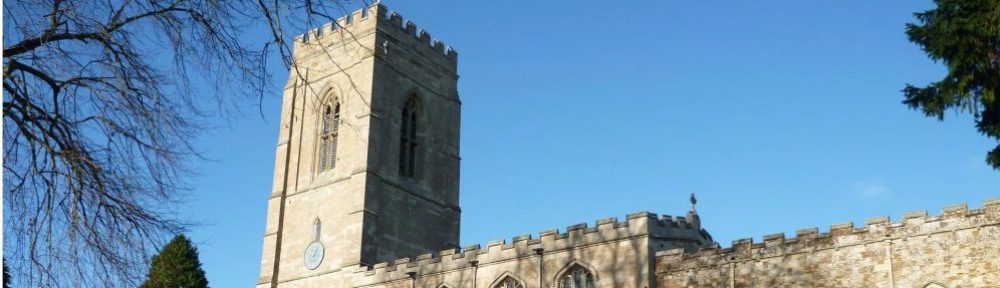
Sunday 28th June, 11am, St Peter’s Chrurch,

The lives of Jesus’ foundational apostles, Peter and Paul, are marked this year on Monday 29th June. However, most churches will celebrate and remember these two remarkable men the day before on Sunday 28th June with services throughtout the Christian communion all over the world.

These two saints are different and yet alike. Both were passionate followers of Jesus, both lost their lives in his name and preaching his gospel, spreading his good word and good news. Yet, their paths to their passion were so different.

The fisherman and the academic

Their status in life before coming to serve Jesus could not have been more different. Peter and his brother Andrew were the first men Jesus called to follow him. They were fishermen, working men, strong and steady, with practical dexterity and honest humanity.

Paul by contrast, was born into a devout Jewish family in Tarsus. He was a Roman citizen, receiving a rigorous Hellenistic upbringing; the educational and cultural framework of the Hellenistic Period (323 – 30BC), which combined classical Greek ideals with the indigenous traditions across the Mediterranean and Near East. It emphasized paideia, an holistic education in literature, rhetoric, philosophy, and physical fitness, designed to create well-rounded, active citizens. He was fluent in both Koine and Classical Greek, allowing him to engage diverse population.

The contrast between the two couldn’t be more stark.

The Passion of Peter and Paul

Both came to Jesus in remarkably different ways. Peter and his brother Andrew were fishing, hauling their nets into their boat. Jesus, standing on the beach as they brought in their nets, called to them and asked them to follow him. He would teach them to be ‘fishers of men’ of people.

They both seemed to drop what they were doing, there and then and said ‘yes’. Quite remarkable when you think that they had families, obligations and their work. But that call was profound and deep. Something about Jesus’ call told them that this was the path they had to follow and that was that.

Paul on the other hand was a far harder challenge. Paul was originally named Saul, by the time we encounter him in the bible, Jesus has died and ascended to heaven. The young church, lead by Peter, Andrew, James, John and all the eleven remaining disciples was growing stronger, becoming a nuisance and gathering followers. For the pharisees, a continuance of the teachings of the man they thought they’d put down.

Saul was a pharisee when Stephen, a young apostle preached Jesus’ word and was seen as a disruptive influence. Stephen preached Jesus’ message before the Sanhedrin. Just like Jesus before him, Stephen was sentenced to death. He was taken outside, where they threw stones at him, until he died.

A young pharisee, Saul, held the coats of the attackers who killed Stephen, watching the horror unfold, mercilessly. Saul was never going to drop everything to follow Jesus. Not in the least bit.

The Conversion of Saul

Travelling to Damascus, Saul was thrown to the ground from his horse by a great light and a voice saying, ‘Why do you persecute me?’ After this apparition, Saul was left sightless. He was in the middle of the road, struck blind. At first, the men traveling with Saul took charge of him. Because he could not see, they led him by the hand and brought him directly into the city of Damascus.

Upon arriving in Damascus, Saul stayed at the house of a man named Judas, which was located on a street called Straight. Saul spent three days at this house, completely blind, fasting, taking neither food nor drink.

Ananias of Damascus

God subsequently sent a Christian disciple named Ananias to visit Saul at Judas’s house. Despite his initial fear of Saul’s reputation as a persecutor, Ananias bravely entered the home, placed his hands on Saul, and welcomed him as “Brother Saul”. Through Ananias, God miraculously restored Saul’s sight, filled him with the Holy Spirit, and baptized him into the Christian faith. After his sight returned, Saul finally ate food and regained his physical strength. He renounced his life before and changed his name from Saul to Paul.

This remarkable account lead to the phrase ‘a Damascene revelation’ or ‘Damascus moment’ when something changes our outlook dramatically and irrefutably.

The first and last apostles

The joy of these two men, who were the first and the last of the Twelve, is that despite their origins and such different beginnings with Jesus, took the young church and its early followers to new places, spreading the word throughout the Middle East, Asia and Europe.

Both spent time in prison for their beliefs, both died cruelly for them.

Both were advocates for Jesus in remarkable ways. Peter, practically, hands on, humane and human. While Paul, intellectually and spiritually, writing some of the most beautiful words ine the Christian canon. Words not spoken by Jesus but written in his name, which resonate and speak to us still.

Peter was the rock, the foundation of Jesus’ church. Peter had the keys to the kingdom of heaven. He is steady, human, an earnest, passionate and sincere man.

Paul, the writer, the thinker, the poet, expresses and interprets Jesus’ words and message in the most uplifting and resonant form. He is the communicator, the messenger we love to hear.

You can see why both are so important to Jesus and his church.

Two remarkable men and two remarkable lives to celebrate!
Remembrance Sunday Hymn

The Story of a Special Hymn

I Vow To Thee My Country’ Sir Cecil Spring Rice, GCMG, GCVO / Gustav Holst

I vow to thee, my country, all earthly things above
Entire and whole and perfect, the service of my love
The love that asks no question, the love that stands the test
That lays upon the altar, the dearest and the best
The love that never falters, the love that pays the price
The love that makes undaunted the final sacrifice

And there’s another country, I’ve heard of long ago
Most dear to them that love her, most great to them that know
We may not count her armies, we may not see her king
Her fortress is a faithful heart, her pride is suffering
And soul by soul, and silently her shining bounds increase
And her ways are ways of gentleness, and all her paths are peace

The text for the hymn comes originally from a poem written originally in about 1908, by a British diplomat and Ambassador to the United States, Sir Cecil Spring Rice, (1859-1918).

Called Urbs Dei (The City of God) or ‘The Two Father Lands‘ the poem explores how a Christian will have two countries , his homeland and his heavenly country.

In 1918 just prior to his death and after the trauma and losses of the First World War, Spring Rice rewrote the first verse to ensure it portrayed themes of love and sacrifice.

Music by Gustav Holst, (1874 – 1934)

It was set to music by Gustav Holst, who, in spite of his insistence on the integrity and completeness of his ‘Planets Suite‘, he himself adapted part of Jupiter to form a tune that fitted the words of the poem .

It was published as a hymn in 1925 in the ‘Songs of Praise‘ hymnbook, which was sadly after Spring Rice’s death on 14th February, 1918

The tune was called ‘Thaxted ‘ after the village where Holst lived for many years.

Longstanding Popularity

‘I Vow to Thee, My Country’ has been popular ever since and was used at the funerals of
Sir Winston Churchill, Princess Diana and Margaret Thatcher.

In 2019 it was voted the Nation’s sixth favourite hymn , despite there being some criticism over it with a question over ” unquestioning obedience”.

It continues to be widely used in Remembrance Services worldwide. 

With very powerful words it continues to resonate with us as we gather to remember the fallen of all conflicts.

Researched by Sue Johnson

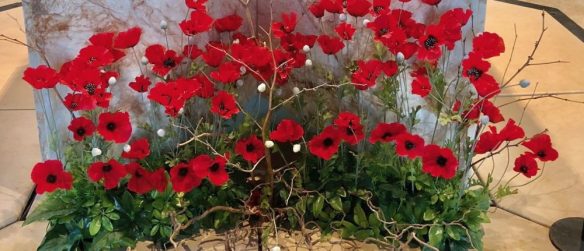
Poppies at the altar of Leicester Cathedral

Raise the Song of Harvest Home

Come Ye Thankful People Come!

One of the most lovely hymns of Harvest; we were delighted to sing it again today at St Peter’s harvest service.

We gathered to celebrate this special service of thanksgiving on a very foggy morning – The top of the Tower obscured from view. Living in what is still very much a rural community, where we are blessed to see our local farmers at work cultivating the land, our Lay Reader, Maxine Johnson, gave thanks in her prayers today for the gift of that sight, we are so accustomed to witnessing, year on year. She gave thanks for farmers, market gardeners and allotmenteers for their diligence and commitment to the land and dedication to their way of life. Dedication and a lifestyle choice from which we all benefit, not only in the form of the food which they produce, but the landscape around us that we see every day.

The landscape here in south Leicestershire, is especially pretty, with its rolling hills and soft valleys – gentleness that is so easily overlooked and possibly dismissed by some. Yet, without it and so many areas of precious farmland found alongside in Rutland, Northamptonshire, Cambridgeshire, Nottinghamshire and Lincolnshire provide some of the best food people enjoy.

We are truly blessed.

Readings today were firstly from Deuteronomy and latterly the Gospel of St John. In the reading from Deuteronomy, the instruction is made as follows:

You shall take some of the first of all the fruit of the ground, which you harvest from your land that the Lord your God gives you, and you shall put it in a basket, and you shall go to the place which the Lord your God will choose, to make his name to dwell there.

The second reading from the Gospel of John, Jesus himself, speaks of food in two different ways, the food our bodies need to live, but the more vital food for our very souls.

“I am the bread of life; whoever comes to me shall not hunger, and whoever believes in me shall never thirst”.

John 6:35

Jesus, as ever, speaks with immense wisdom and understanding of people. Before making this beautiful statement, he talks to the people who followed him after he fed them on the mountain with fish and bread. His instinct was that they had eaten so well, they wanted to be fed again. So understandable, but his lesson was that food from the earth, does not last and only sustains the body. Earthly food does not feed the soul.

He argued that his ‘food’ was the bread of eternal life and is unfaltering. He, himself, is the food we all need. When we believe and follow him, our lives will be enriched and sustained, however hard our earthly struggles may be. He is with us, inside us, keeping us going and even carrying us at times.

What an extraordinary message and gift? Definitely, something to sing loud and joyfully!

All proceeds from the service today to The Well at Kibworth.

Come, ye thankful people, come,
raise the song of harvest home;
all is safely gathered in,
ere the winter storms begin.
God our Maker doth provide
for our wants to be supplied;
come to God’s own temple, come,
raise the song of harvest home.

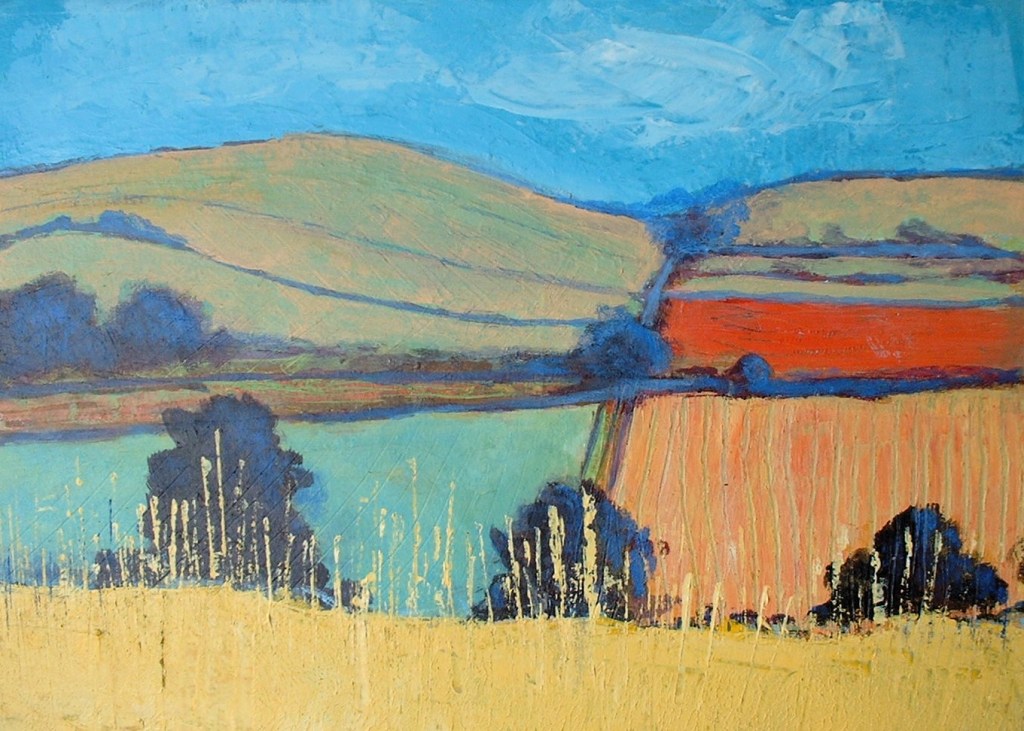
Maxine Dodd artist, painting, 'Harvest' shows the fields in the Langtons - bold and colourful, with wheat and blue skies
‘Harvest’ by Maxine Dodd