St Peter and St Paul’s Day 2026

Join us to celebrate two foundational apostles

Sunday 28th June, 11am, St Peter’s Chrurch,

The lives of Jesus’ foundational apostles, Peter and Paul, are marked this year on Monday 29th June. However, most churches will celebrate and remember these two remarkable men the day before on Sunday 28th June with services throughtout the Christian communion all over the world.

These two saints are different and yet alike. Both were passionate followers of Jesus, both lost their lives in his name and preaching his gospel, spreading his good word and good news. Yet, their paths to their passion were so different.

The fisherman and the academic

Their status in life before coming to serve Jesus could not have been more different. Peter and his brother Andrew were the first men Jesus called to follow him. They were fishermen, working men, strong and steady, with practical dexterity and honest humanity.

Paul by contrast, was born into a devout Jewish family in Tarsus. He was a Roman citizen, receiving a rigorous Hellenistic upbringing; the educational and cultural framework of the Hellenistic Period (323 – 30BC), which combined classical Greek ideals with the indigenous traditions across the Mediterranean and Near East. It emphasized paideia, an holistic education in literature, rhetoric, philosophy, and physical fitness, designed to create well-rounded, active citizens. He was fluent in both Koine and Classical Greek, allowing him to engage diverse population.

The contrast between the two couldn’t be more stark.

The Passion of Peter and Paul

Both came to Jesus in remarkably different ways. Peter and his brother Andrew were fishing, hauling their nets into their boat. Jesus, standing on the beach as they brought in their nets, called to them and asked them to follow him. He would teach them to be ‘fishers of men’ of people.

They both seemed to drop what they were doing, there and then and said ‘yes’. Quite remarkable when you think that they had families, obligations and their work. But that call was profound and deep. Something about Jesus’ call told them that this was the path they had to follow and that was that.

Paul on the other hand was a far harder challenge. Paul was originally named Saul, by the time we encounter him in the bible, Jesus has died and ascended to heaven. The young church, lead by Peter, Andrew, James, John and all the eleven remaining disciples was growing stronger, becoming a nuisance and gathering followers. For the pharisees, a continuance of the teachings of the man they thought they’d put down.

Saul was a pharisee when Stephen, a young apostle preached Jesus’ word and was seen as a disruptive influence. Stephen preached Jesus’ message before the Sanhedrin. Just like Jesus before him, Stephen was sentenced to death. He was taken outside, where they threw stones at him, until he died.

A young pharisee, Saul, held the coats of the attackers who killed Stephen, watching the horror unfold, mercilessly. Saul was never going to drop everything to follow Jesus. Not in the least bit.

The Conversion of Saul

Travelling to Damascus, Saul was thrown to the ground from his horse by a great light and a voice saying, ‘Why do you persecute me?’ After this apparition, Saul was left sightless. He was in the middle of the road, struck blind. At first, the men traveling with Saul took charge of him. Because he could not see, they led him by the hand and brought him directly into the city of Damascus.

Upon arriving in Damascus, Saul stayed at the house of a man named Judas, which was located on a street called Straight. Saul spent three days at this house, completely blind, fasting, taking neither food nor drink.

Ananias of Damascus

God subsequently sent a Christian disciple named Ananias to visit Saul at Judas’s house. Despite his initial fear of Saul’s reputation as a persecutor, Ananias bravely entered the home, placed his hands on Saul, and welcomed him as “Brother Saul”. Through Ananias, God miraculously restored Saul’s sight, filled him with the Holy Spirit, and baptized him into the Christian faith. After his sight returned, Saul finally ate food and regained his physical strength. He renounced his life before and changed his name from Saul to Paul.

This remarkable account lead to the phrase ‘a Damascene revelation’ or ‘Damascus moment’ when something changes our outlook dramatically and irrefutably.

The first and last apostles

The joy of these two men, who were the first and the last of the Twelve, is that despite their origins and such different beginnings with Jesus, took the young church and its early followers to new places, spreading the word throughout the Middle East, Asia and Europe.

Both spent time in prison for their beliefs, both died cruelly for them.

Both were advocates for Jesus in remarkable ways. Peter, practically, hands on, humane and human. While Paul, intellectually and spiritually, writing some of the most beautiful words ine the Christian canon. Words not spoken by Jesus but written in his name, which resonate and speak to us still.

Peter was the rock, the foundation of Jesus’ church. Peter had the keys to the kingdom of heaven. He is steady, human, an earnest, passionate and sincere man.

Paul, the writer, the thinker, the poet, expresses and interprets Jesus’ words and message in the most uplifting and resonant form. He is the communicator, the messenger we love to hear.

You can see why both are so important to Jesus and his church.

Two remarkable men and two remarkable lives to celebrate!
Easter Worship – Easter Sunday

Services for Easter Sunday take place at St Peter’s and throughout the day at our churches in the Launde Deanery Community – See all the details here:

Easter Sunday

Easter services at St Peter’s Church this Easter and next week a special family service at Thorpe Langton on Sunday 12th April, as some of our families are away over the holidays. Everyone welcome.

  • Easter Sunday, St Peter’s Church, 5th April 11.00am

Easter Sunday

After the sorrow of Good Friday and the quietness of Easter Saturday, Easter Sunday celebrates the great mystery and heart of the Christian faith, that Jesus came back to life, rising from death, his body restored and whole again. Christians call this ‘The Resurrection’

For God so loved the world that he gave his only Son, so that everyone who believes in him may not perish but may have eternal life.
John 3.16

The Resurrection

On the morning of the third day after Jesus died, the gospels recount his coming back to life. Versions between the accounts differ slightly, but either singly or as a group, the first people to learn of his resurrection were women, notably Mary, who mistook Jesus for the gardener. When he spoke to her and said her name, she recognised him and reached out to touch him. He gently told her not to, as he was not yet ascended to his Father.

This moment is profound on many levels. Jesus asked Mary, ‘Whom do ye seek’ Who are you looking for?’ A deep question for us all on this day. Who do we look for, whom do we seek? What do we want and what do we need? If we seek Jesus, what does finding him mean to our lives both now and in the future?

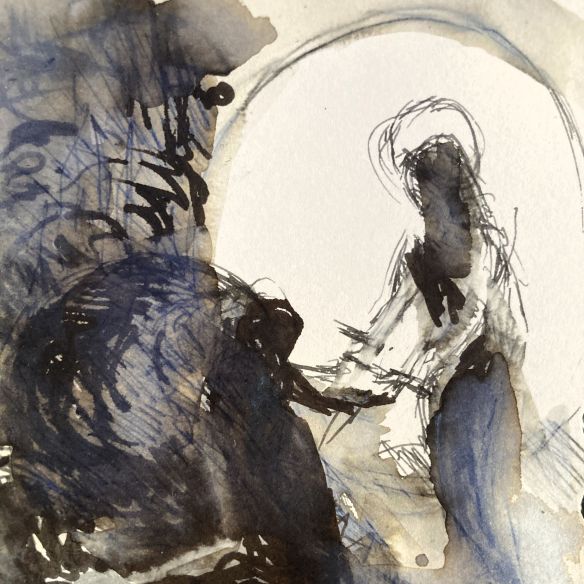
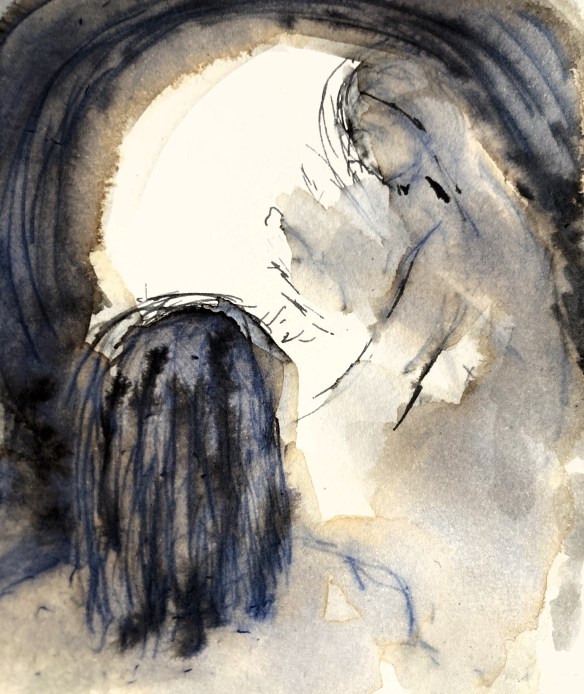
In the mouth of the tomb, 'Who do ye seek?' Jesus greets Mary against the sunlight, with arm outstretched to lead her from the darkness to the light
Whom do ye seek?

For our children, this lovely day is a promise of Easter eggs and possibly an Easter egg hunt! Read all about different ways to remember Jesus while enjoying that very special Easter egg!

Alleluia! He is risen!

He is risen indeed, ‘Alleluia!’

The main feeling today is one of joy. A love supreme and glorious in its mystery offered to us all without reservation or restraint.

The Church of England has a really useful guide online called Easter Day, Fact File which you might enjoy reading

Jesus and Mary on Easter morning by Maxine Dodd, pen and ink sketch, showing Mary and Jesus silhouetted against a large sun in the mouth of the tomb
Jesus and Mary on Easter morning

Easter Worship – Good Friday

Services for Good Friday take place throughout the day at our churches in the Launde Deanery Community – See all the details here:

Good Friday and Easter Sunday

Two services at St Peter’s Church this Easter and a family service for children at Thorpe Langton on Sunday 12th April, as some of our families are away over the holidays. Everyone welcome.

  • Good Friday Reflection, 2pm – 3pm and
  • Easter Sunday 5th April 11.00am

Good Friday

Good Friday is the most sombre and saddest day of the Christian calendar. We remember Jesus’s death upon the Cross; the most brutal end to life we could imagine. We remember his sacrifice, his promises and kindness to the prisoner crucified with him and the awful moment we all feel at times, that God, his father abandoned him in his greatest hour of need.

Why is it Called Good Friday?

This strange name for something so horrendous seems almost cruel in its irony. The reason for this paradox perhaps, lies in the evolution of our language and the way words change their meaning over time. The word ‘good’ in older times also meant ‘pious’ and reflected personal behaviour. In other words, ‘being good’. So ‘Good Friday’ was a day to observe, pray, fast and remember the death of Jesus. To be ‘good’ on that Friday and behave appropriately, as we would when a loved-one dies, seems more understandable in that context.

The real reason why Good Friday is ‘Good’

‘Good Friday’ though has always been about hope in the worst of times. The word, ‘good’ is used for this day, because Jesus’s dreadful death was not the end. In fact, it was the beginning. Jesus’s suffering and death on his cross was the last sacrifice. Everyone who comes to him will find salvation and love.

The most beautiful gift of love and new life, which can be described with only one word…GOOD

Good Friday for children

Traditionally, in the UK, Good Friday is marked by eating hot cross buns – a lovey soft bread flavoured with cinnamon and marked with crosses, served hot and oozing with butter! A super treat after six weeks of restraint during Lent. Hot cross buns are on sale everywhere and throughout the year, but to enjoy one on Good Friday is a real treat.

Making an Easter Garden

Making an Easter Garden, or drawing or painting one is a lovely Good Friday activity. These miniature gardens are made simply on a plant pot tray, with a little plant pot disguised as the tomb, with a cloth inside and a stone cover. This stone comes off on Easter Sunday. The surrounding tray is filled with little plants or grass to represent the hill and topped with the three crosses, of Jesus and the two men crucified alongside him.

More details can be found here

The Church of England has a really useful guide online called Good Friday Fact File which you might enjoy reading

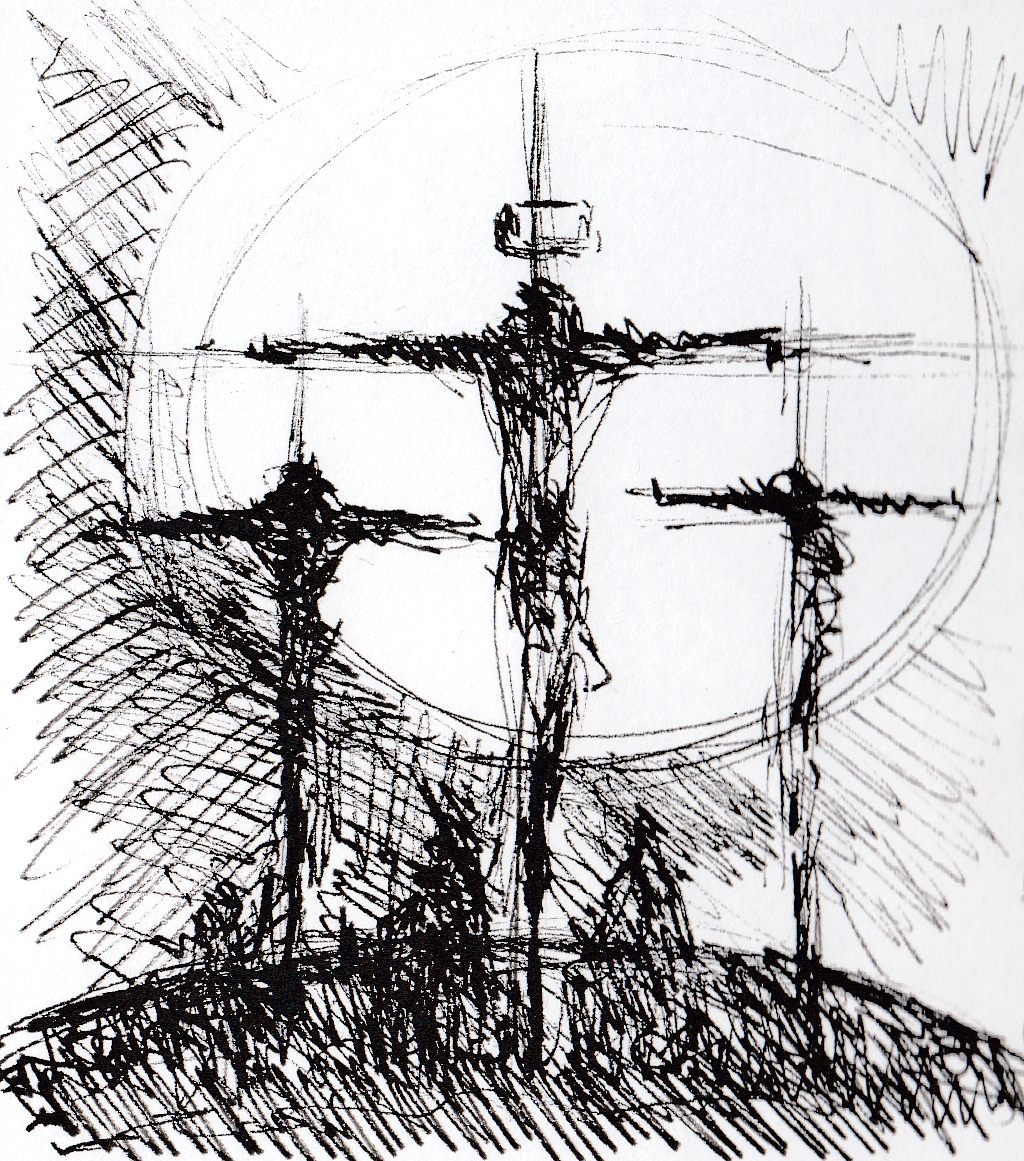
Three Crosses on the hillside a drawing by Maxine Dodd artist in pen and ink on white paper - The three crosses and hanging figures are seen in silhouette with a large white sun behind - the figures of Mary and John are suggested below Jesus in the centre
Three crosses on the hillside, pen and ink drawing by Maxine Dodd